
- Current location:Home page >> health information
How to perform a breast self-examination?
2026-09-16 17:47:27
How to perform a breast self-examination?
Breast self-examination is an important method for women to detect breast abnormalities early. Regular self-examination can help identify breast changes and seek medical treatment in time.The main contents includeCheck timing, observe changes in appearance, touch techniquesandAbnormal signal identification.It is recommended to do it one week after the end of menstruation every month, when the breast condition is most stable.Self-examination is divided into two steps: "looking" and "touching". Pay attention to symmetry, abnormal appearance such as skin depression or redness, as well as tactile changes such as lumps and pain.If you find any abnormalities, you should seek medical treatment promptly to avoid panic self-diagnosis.
Step 1: Choose the right time and environment
Breast self-examination should be7-10 days after menstruation endsAs a result, hormone levels are stable and breast swelling is reduced.Choose a private space with sufficient light. You can stand or lie down. It is recommended to face the mirror and observe when standing. When lying down, you can put pillows under your shoulders to flatten your breasts.Keep your hands clean before the examination and avoid applying skin care products that interfere with touch.It is recommended to check on the same day every month to facilitate comparison of changes.
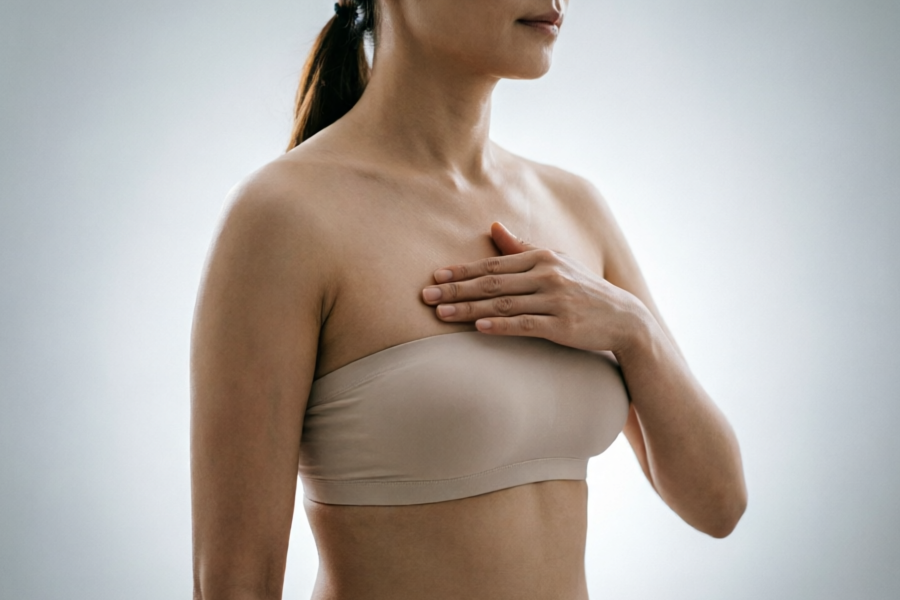
Step Two: Observe Appearance and Symmetry
facing the mirrorObserve breast contour, pay attention to whether both sides are symmetrical, and whether the skin has depressions (similar to orange peel), redness, swelling or ulcers.Observe the dynamic changes of the breasts while placing your hands on your hips, lifting or pressing your waist.Nipples should be inspected for inversion, discharge, or crusting.If you find that one breast suddenly enlarges, the nipple shifts, or the skin color changes, you should record the degree of change and seek medical consultation.
Step Three: System Touch Check Technique
useFingertips instead of fingertipsApply pressure to the breast and examine it in a clockwise spiral from outside to inside, or in a vertical direction from top to bottom in rows.The strength is divided into three levels: light, medium and heavy to ensure coverage of breast tissue (from collarbone to lower edge of bra, armpit to sternum).Pay special attention to the upper outer quadrant of the breast (near the armpit), where glands are densely packed and disease is common.During the examination, pay attention to whether there are hard lumps, thickened areas or tenderness, and squeeze the nipple to observe whether there is any discharge.
Exception signals and subsequent processing
If foundPainless lumps, skin dimpling, bloody dischargeOr if there are obvious changes in a short period of time, you need to see a doctor within 1-2 weeks.Pay attention to distinguish physiological masses (such as granular before menstruation) and pathological masses (fixed, unclear boundaries).Self-examination cannot replace medical examination. It is recommended to combine annual clinical physical examination and ultrasound/mammography examination.Recording self-examination results facilitates tracking and avoids excessive anxiety. About 80% of breast lumps are benign (data source:American Cancer Society 2022 Report).
| Comparison of common breast abnormalities | Physiological changes | Be wary of symptoms |
|---|---|---|
| Mass characteristics | Soft, removable, shrinks after menstruation | Hard, fixed, continuously growing |
| Pain manifestations | periodic pain | persistent local stinging |
Quote sources:
1. World Health Organization "Breast Cancer Prevention and Treatment Guidelines" (2021 Edition)
2. "Breast Health Handbook" by the Chinese Anti-Cancer Association
3. For clinical recommendations, refer to the palpation techniques of Dr. Lisa Jacobs of the Johns Hopkins University Breast Center.
4. Recommended breast self-examination tools:FormicaSelf-check card (Manufacturer: Shenzhen Carnation Medical Technology Co., Ltd.)
Relevant knowledge
- 2026-10-01What is female beauty?
- 2026-09-30How can women supplement calcium scientifically?
- 2026-09-30What is calcium supplementation?
- 2026-09-30How often should bone density checks be done?
- 2026-09-29How to prevent osteoporosis?
- 2026-09-29Why are women prone to osteoporosis?
- 2026-09-29What is osteoporosis?
- 2026-09-28Is hormone replacement therapy safe?
- 2026-09-28What is hormone replacement therapy?
- 2026-09-28How to manage menopause?
- 2026-09-28What are the symptoms of menopause?
- 2026-09-28What is menopause?
- 2026-09-28What does a postpartum review include?
- 2026-09-27What is a postpartum review?
- 2026-09-27Is pelvic floor muscle repair necessary?
- 2026-09-27What is postpartum pelvic floor muscle repair?
- 2026-09-27How to lose weight scientifically after giving birth?
- 2026-09-26What is postpartum weight loss?
Chinese medicinal materials
More-
View
The efficacy and function of locust bean
Overview of the efficacy and functions of locust beanSophora bean, also known as Sophora japonica or Sophora japonica, is the mature fruit of Sophora japonica tree, a leguminous plant, and has various medicinal values in traditional medicine.Its main functions includeClears away heat and cools blood, moisturizes intestines and relieves constipation, lowers blood pressure, and resists oxidationetc., suitable for relieving symptoms such as hemorrhoids, bloody stools, and high blood pressure.Modern
-

View
The efficacy and function of Baiziren
Overview of the efficacy and functions of BaizirenBaiziren is the dried and mature seed kernel of Platycladus orientalis, a plant in the Cupressaceae family. Traditional Chinese medicine believes that it is flat in nature and sweet in taste, and can be used to regulate the heart, kidney, and large intestine meridians.Nourish the heart and calm the nerves, moisturize the intestines and relieve constipation, and nourish the liver and kidneysand other effects.Modern research shows that cypress seed
-

View
The efficacy and function of plum slices
Overview of the effects and functions of plum slicesPlum slices, also known as borneol or dipterocarp, is a traditional Chinese medicinal material that has the effects of rejuvenating the mind, clearing away heat and relieving pain, reducing swelling and promoting muscle growth.Its main component is dextroborneol, which is widely used in the fields of medicine, cosmetics and spices.The core functions of plum slices include relieving headaches, anti-inflammatory and sterilizing, promoting wound h
-

View
Efficacy and functions of Kochia bark
Overview of the efficacy and functions of Kochia barkKochia bark, also known as broom seedling, is a commonly used medicinal material in traditional Chinese medicine for clearing away heat and promoting dampness.Diuretic and relieve stranguria, dispel wind and relieve itching, clear away heat and detoxifyand other effects.It mainly acts on urinary system inflammation, skin itching and damp-heat jaundice, and is widely used clinically.Secondary functions include assisting in lowering blood sugar,
-

View
Efficacy and functions of Baiziren
Overview of the efficacy and functions of BaizirenBaiziren is the dried and mature seed kernel of Platycladus orientalis, a plant in the Cupressaceae family. Traditional Chinese medicine believes that it is flat in nature and sweet in taste, and can be used to regulate the heart, kidney, and large intestine meridians.Nourish the heart and calm the nerves, moisturize the intestines and relieve constipation, and nourish the liver and kidneysand other effects.Its main functions include improving sy
-

View
Eclipta Eclipta efficacy and functions
Overview of the efficacy and functions of EcliptaEclipta, also known as Eclipta or Eclipta, is a commonly used medicinal material in traditional Chinese medicine to nourish the liver and kidneys, cool blood and stop bleeding.Its core functions includeNourishes yin and nourishes kidney, blackens beard and hair, stops bleeding and reduces inflammation, the secondary effects involve improving hair loss, relieving gum bleeding and skin eczema.The primary and secondary structure is clear: liver and k
-

View
Function and role of hippocampus
Overview of the functions and functions of the hippocampusSeahorse is a precious marine creature recognized for its many benefits in both traditional medicine and modern research.Its main functions includeReplenishing kidneys and strengthening yang, anti-fatigue, regulating immunity, antioxidantetc., especially the effect of nourishing kidney and replenishing qi is the most prominent.In addition, the hippocampus also plays a certain role in improving blood circulation and relieving neurasthenia.
-

View
The effects and functions of fragrant fruit
Overview of the effects and functions of fragrant fruitXiangguo, also known as Ligusticum chuanxiong or Shannai, is a plant with both medicinal and edible value, and its rhizomes are often used in traditional Chinese medicine.Its main functions includePromotes blood circulation and removes blood stasis, dispels wind and relieves pain, improves blood circulation, the secondary effects involve relieving headaches, joint pain and women’s menstrual discomfort.The active ingredients of xiangguo, su
-

View
Efficacy and functions of Cistanche deserticola
Overview of the efficacy and functions of Cistanche deserticolaCistanche deserticola, also known as Cistanche deserticola, is a traditional Chinese medicinal material mainly produced in desert areas and is known as "desert ginseng".Its core functions includeReplenishing kidney yang, replenishing essence and blood, moistening intestines and laxative, the secondary effects involve anti-aging, regulating immunity, etc.This article will start from its medicinal value, suitable people, usage methods
-

View
White peony effect and function
Overview of the efficacy and functions of white peony rootWhite peony root is a commonly used blood-nourishing and menstrual-regulating medicine in traditional Chinese medicine.Nourishes blood and softens liver, relieves pain, astringes yin and stops sweatingIt has core functions such as irregular menstruation, hypochondriac pain, spontaneous sweating and night sweats.Its functions can be divided into two categories: primary and secondary:Main functionsIncluding regulating female endocrine, reli
-

View
Efficacy and functions of Wu Hua Xue Teng
Overview of the efficacy and functions of SpatholobusFive-flowered bloodvine is a traditional Chinese medicinal material, which mainly hasPromotes blood circulation and removes blood stasis, unblocks collaterals to relieve pain, expels wind and removes dampnessIt has other effects and is often used to treat rheumatic arthralgia, bruises and irregular menstruation.Its core function is to promote blood circulation, relieve inflammation and pain, and its secondary functions include assisting in reg
-
View
The efficacy and function of Tianqingdibai
Overview of the efficacy and functions of TianqingdibaiTianqing Dibai is a traditional Chinese medicinal material that has the effects of clearing heat and detoxifying, cooling blood and stopping bleeding, reducing swelling and dissipating stagnation. It is often used to treat sore throat, carbuncle sores, bruises and other diseases.Its main components include flavonoids, organic acids and other active substances. Modern research shows that it has certain anti-inflammatory and antibacterial effe