
- Current location:Home page >> Traditional Chinese Medicine Health Care
How to distinguish real and fake ginseng?
2026-04-24 15:08:36
How to distinguish real and fake ginseng? Master key methods to avoid being deceived
As a precious Chinese medicinal material, ginseng is mixed with real and fake products on the market. Consumers need to make a comprehensive judgment based on appearance, smell, texture and other aspects. This article will start fromMorphological characteristics, cross-section observation, taste identification, price differencesFour core dimensions unfold to help you quickly identify authenticity. Key points include: real ginseng has obvious reed heads and natural texture, while fake ginseng has many artificial traces; real ginseng has chrysanthemum patterns on the cross section, while fake ginseng has a blurry texture; real ginseng has a sweet and slightly bitter taste, while fake ginseng may have a chemical odor; high prices may not guarantee authenticity, and need to be verified with other characteristics.
1. Morphological characteristics: detailed comparison of reed heads, texture and roots
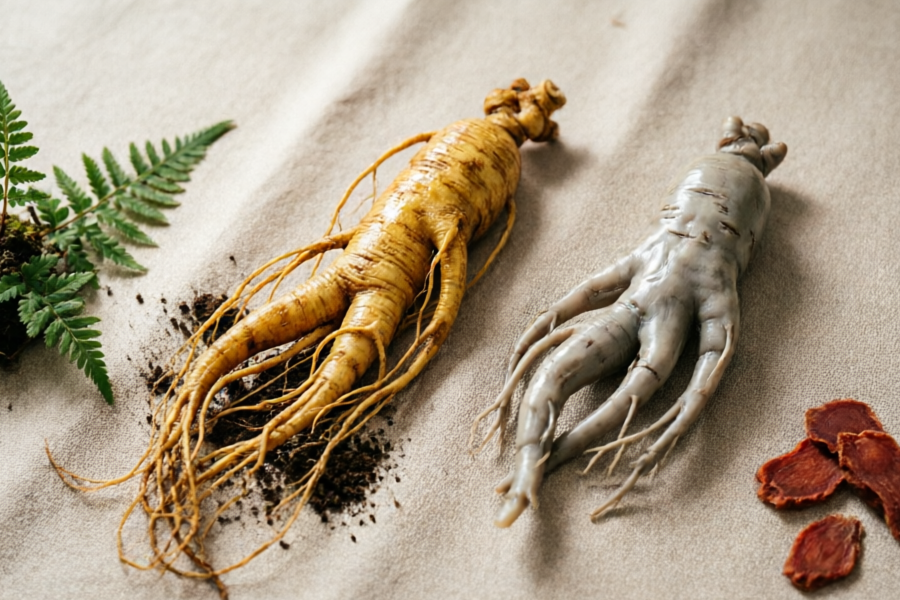
The most distinctive feature of real ginseng isReed head (rhizome part)It is obvious that it is in the shape of discs and is commonly known as "goose-necked reed". However, the head of the false ginseng reed is short or artificially bonded. The main root of real ginseng is thick, with horizontal ring lines and vertical wrinkles on the surface, and the texture is naturally scattered; the lines of fake ginseng may be too regular or pressed by molds. In addition, true ginseng fibrous roots are slender and flexible, often with pearl-like protrusions (warts), while false ginseng fibrous roots are easy to break and have a smooth surface. For example,wild ginsengThe "iron lines" and "pearl whiskers" are natural features that are difficult to imitate artificially.
2. Cross-section observation: chrysanthemum pattern and color reveal authenticity
After cutting the ginseng, the cross section of the ginseng isYellowish white or light brown, there are obvious "chrysanthemum patterns" (radial cracks), and the texture is tight; fake ginseng may be pretended to be pokeweed, platycodon and other plants, and the texture of the cut surface is messy or hollow. If soaked in water, the water quality of real ginseng will be clear, while fake ginseng may be discolored or turbid. According to the "Chinese Pharmacopoeia", the cross-section of high-quality ginseng should be "powdery, with layers of ring-like brown color", while inferior products are often abnormally pale in color due to sulfur fumigation.
3. Smell and taste: The sweetness of bitterness is a natural sign
Real ginseng has a fragrant smell, is slightly bitter at first and then sweet, and has no residue after chewing; fake ginseng may have a sour, spicy or chemical smell. For example,red ginsengIt has a caramel aroma due to the steaming process, while sulfur-smoked fake ginseng has a pungent sulfur smell. It should be noted that some unscrupulous businesses will add sweeteners to imitate the sweetness, but the sweetness of real ginseng is long-lasting and natural. Li Shizhen of the Ming Dynasty emphasized in "Compendium of Materia Medica": "The real ginseng is fragrant and sweet, while the fake ginseng has a turbid and sour taste."
4. Price and Channels: Rational Consumption to Avoid Traps
Prices of ginseng in the market vary greatly, butlow price promotionNeed to be vigilant. For example, wild ginseng can cost hundreds of yuan per gram, while garden ginseng is affordable. It is recommended to choose formal channels such asTongrentang, Kangmei PharmaceuticalBrand products and avoid street stalls or unlicensed online stores. The following table lists common ginseng types and reference prices:
| Type | Features | Reference price (yuan/gram) |
|---|---|---|
| wild ginseng | The reeds have long and dense grains and pearl whiskers | 200-800 |
| Ginseng | The reed head is short and the lines are shallow. | 50-200 |
| Garden ginseng | Thick body, less beard, less lines | 5-20 |
Comprehensive identification: multi-dimensional verification to ensure quality
Distinguishing true and false ginseng requires combinationSee, feel, smell, taste, valueThe five-step method cannot be judged alone. Ask for a test report when purchasing and pay attention to whether there is "organic certification" or "geographical indication". If used for medicinal purposes, it is recommended to consult a traditional Chinese medicine practitioner. Remember, the natural characteristics of real ginseng are difficult to completely replicate. Only by consuming rationally can you avoid being deceived by "artificial beauty ginseng".
Quote sources:1. "Chinese Pharmacopoeia" 2020 edition (National Pharmacopoeia Commission) 2. "Compendium of Materia Medica" (Li Shizhen, Ming Dynasty) 3. Brand reference: Tongrentang (Beijing Tongrentang), Kangmei Pharmaceutical (Kangmei Red Ginseng) 4. Data support: Jilin Provincial Ginseng Science Research Institute Market Research Report (2023)
Relevant knowledge
- 2026-10-01How to maintain health at the beginning of autumn?
- 2026-09-30How to maintain health during the hot summer?
- 2026-09-30How to maintain health during Xiaoshu?
- 2026-09-30How to maintain health during the summer solstice?
- 2026-09-29How to maintain the health of Eargrass?
- 2026-09-29How does Xiaoman maintain his health?
- 2026-09-29How to maintain health in Beginning of Summer?
- 2026-09-29How to maintain health during Guyu?
- 2026-09-28How to maintain health during Qingming Festival?
- 2026-09-28How to maintain health during the Spring Equinox?
- 2026-09-28How to maintain health in Jingzhe?
- 2026-09-28How to maintain health through rainwater?
- 2026-09-28How to maintain health at the beginning of spring?
- 2026-09-28What is the relationship between the twenty-four solar terms and health preservation?
- 2026-09-27How to prevent cold evil in winter?
- 2026-09-27How to take care of your emotions in winter?
- 2026-09-27What should you pay attention to when dressing in winter?
- 2026-09-26What should you pay attention to when sleeping in winter?
Chinese medicinal materials
More-
View
The efficacy and function of purple beads
Overview of the efficacy and functions of purple beadsPurpurea is a plant with medicinal value. Its leaves, roots and fruits can be used as medicine. Its main functions includeStop bleeding, reduce inflammation, clear away heat and detoxify, dissipate blood stasis and reduce swellingWait.In traditional medicine, purple pearls are often used to treat symptoms such as traumatic bleeding, bruises, and sore throat. Modern research has also found that it contains active ingredients such as flavonoids
-
View
The efficacy and function of locust bean
Overview of the efficacy and functions of locust beanSophora bean, also known as Sophora japonica or Sophora japonica, is the mature fruit of Sophora japonica tree, a leguminous plant, and has various medicinal values in traditional medicine.Its main functions includeClears away heat and cools blood, moisturizes intestines and relieves constipation, lowers blood pressure, and resists oxidationetc., suitable for relieving symptoms such as hemorrhoids, bloody stools, and high blood pressure.Modern
-
View
The efficacy and function of Baiziren
Overview of the efficacy and functions of BaizirenBaiziren is the dried and mature seed kernel of Platycladus orientalis, a plant in the Cupressaceae family. Traditional Chinese medicine believes that it is flat in nature and sweet in taste, and can be used to regulate the heart, kidney, and large intestine meridians.Nourish the heart and calm the nerves, moisturize the intestines and relieve constipation, and nourish the liver and kidneysand other effects.Modern research shows that cypress seed
-
View
The efficacy and function of plum slices
Overview of the effects and functions of plum slicesPlum slices, also known as borneol or dipterocarp, is a traditional Chinese medicinal material that has the effects of rejuvenating the mind, clearing away heat and relieving pain, reducing swelling and promoting muscle growth.Its main component is dextroborneol, which is widely used in the fields of medicine, cosmetics and spices.The core functions of plum slices include relieving headaches, anti-inflammatory and sterilizing, promoting wound h
-
View
Efficacy and functions of Kochia bark
Overview of the efficacy and functions of Kochia barkKochia bark, also known as broom seedling, is a commonly used medicinal material in traditional Chinese medicine for clearing away heat and promoting dampness.Diuretic and relieve stranguria, dispel wind and relieve itching, clear away heat and detoxifyand other effects.It mainly acts on urinary system inflammation, skin itching and damp-heat jaundice, and is widely used clinically.Secondary functions include assisting in lowering blood sugar,
-
View
Efficacy and functions of Baiziren
Overview of the efficacy and functions of BaizirenBaiziren is the dried and mature seed kernel of Platycladus orientalis, a plant in the Cupressaceae family. Traditional Chinese medicine believes that it is flat in nature and sweet in taste, and can be used to regulate the heart, kidney, and large intestine meridians.Nourish the heart and calm the nerves, moisturize the intestines and relieve constipation, and nourish the liver and kidneysand other effects.Its main functions include improving sy
-
View
Eclipta Eclipta efficacy and functions
Overview of the efficacy and functions of EcliptaEclipta, also known as Eclipta or Eclipta, is a commonly used medicinal material in traditional Chinese medicine to nourish the liver and kidneys, cool blood and stop bleeding.Its core functions includeNourishes yin and nourishes kidney, blackens beard and hair, stops bleeding and reduces inflammation, the secondary effects involve improving hair loss, relieving gum bleeding and skin eczema.The primary and secondary structure is clear: liver and k
-

View
Function and role of hippocampus
Overview of the functions and functions of the hippocampusSeahorse is a precious marine creature recognized for its many benefits in both traditional medicine and modern research.Its main functions includeReplenishing kidneys and strengthening yang, anti-fatigue, regulating immunity, antioxidantetc., especially the effect of nourishing kidney and replenishing qi is the most prominent.In addition, the hippocampus also plays a certain role in improving blood circulation and relieving neurasthenia.
-
View
The effects and functions of fragrant fruit
Overview of the effects and functions of fragrant fruitXiangguo, also known as Ligusticum chuanxiong or Shannai, is a plant with both medicinal and edible value, and its rhizomes are often used in traditional Chinese medicine.Its main functions includePromotes blood circulation and removes blood stasis, dispels wind and relieves pain, improves blood circulation, the secondary effects involve relieving headaches, joint pain and women’s menstrual discomfort.The active ingredients of xiangguo, su
-
View
Efficacy and functions of Cistanche deserticola
Overview of the efficacy and functions of Cistanche deserticolaCistanche deserticola, also known as Cistanche deserticola, is a traditional Chinese medicinal material mainly produced in desert areas and is known as "desert ginseng".Its core functions includeReplenishing kidney yang, replenishing essence and blood, moistening intestines and laxative, the secondary effects involve anti-aging, regulating immunity, etc.This article will start from its medicinal value, suitable people, usage methods
-
View
White peony effect and function
Overview of the efficacy and functions of white peony rootWhite peony root is a commonly used blood-nourishing and menstrual-regulating medicine in traditional Chinese medicine.Nourishes blood and softens liver, relieves pain, astringes yin and stops sweatingIt has core functions such as irregular menstruation, hypochondriac pain, spontaneous sweating and night sweats.Its functions can be divided into two categories: primary and secondary:Main functionsIncluding regulating female endocrine, reli
-
View
Efficacy and functions of Wu Hua Xue Teng
Overview of the efficacy and functions of SpatholobusFive-flowered bloodvine is a traditional Chinese medicinal material, which mainly hasPromotes blood circulation and removes blood stasis, unblocks collaterals to relieve pain, expels wind and removes dampnessIt has other effects and is often used to treat rheumatic arthralgia, bruises and irregular menstruation.Its core function is to promote blood circulation, relieve inflammation and pain, and its secondary functions include assisting in reg