
- Current location:Home page >> Traditional Chinese Medicine Health Care
What is the combination of water and fire in traditional Chinese medicine?
2026-03-26 23:44:32
"Water and Fire" in Traditional Chinese Medicine: The way to balance the heart and kidneys
"Water and fire are both harmonious" is an important concept in traditional Chinese medicine theory to describe the physiological relationship between the heart and kidneys. It originates from the hexagram thinking in the "Book of Changes" and refers to the state in which heart fire and kidney water are coordinated with each other and the upper and lower parts are harmonious. The heart belongs to fire and governs yang energy; the kidneys belong to water and governs yin essence. The two nourish each other through the meridians and maintain the balance of yin and yang in the human body. If there is an imbalance between water and fire (such as "heart and kidney disharmony"), symptoms such as insomnia, heart palpitations, and soreness and weakness in the waist and knees may occur. This article will start from four parts: theoretical connotation, physiological manifestations, harm of disorders and conditioning methods, and systematically elaborate on this core theory by combining classic books and modern applications.
1. Theoretical Origin and Core Connotation
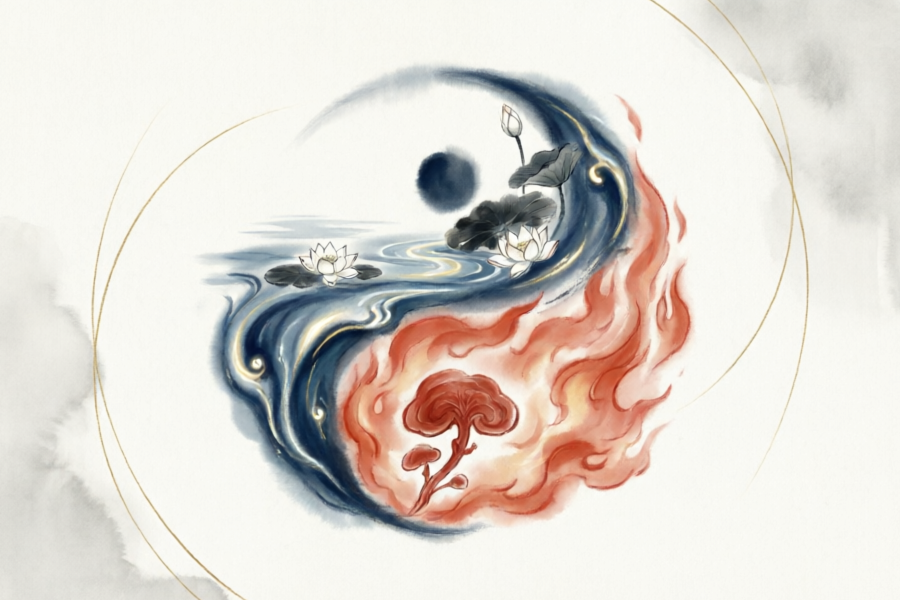
"Water and fire are both harmonious" was first seen in the "Huangdi Neijing", and was later deepened by the Ming Dynasty physician Zhang Jingyue in "Leijing" and proposed the physiological model of "intersection of heart and kidney". The heart fire needs to be lowered to warm the kidney water to prevent excessive yin and cold; the kidney water needs to be raised to nourish the heart fire and avoid excessive yang. This dynamic balance is similar to the harmonious state of water and fire in nature. Traditional Chinese medicine believes that sleep quality, emotional stability, reproductive function, etc. are all related to this. For example, Huanglian Ejiao Decoction in "Treatise on Febrile Diseases" is a classic prescription for "heart-kidney disharmony", which restores balance by nourishing yin and reducing fire.
2. Physiological manifestations and disorder signals
Healthy water and fire balance manifests as energetic energy, stable sleep, warm hands and feet, and smooth bowel movements. On the contrary, if the heart fire is excessive (such as staying up late for a long time, overthinking), or the kidney water is insufficient (such as old age, frailty, long-term illness and consumption of essence), symptoms of upper heat and lower cold will appear: hot and dry upper body, dry mouth and tongue, fear of cold in the lower body, and frequent nocturia. Li Zhongzi, a physician in the Ming Dynasty, emphasized in "Must-Read by Medical Zong": "If the heart and kidneys are not in harmony, all kinds of diseases will arise", and listed typical symptoms such as tinnitus, forgetfulness, and spermatorrhea. Common modern neurasthenia and menopausal syndrome are also related to this.
3. Conditioning methods and practical suggestions
Traditional Chinese medicine regulates water and fire and focuses on "connecting the heart and kidneys": first, drug therapy, such as Jiaotai Pills (coptis chinensis and cinnamon compatibility) can induce fire and return to the original element; Liuwei Dihuang Pills nourish kidney yin. The second is non-drug therapy. Moxibustion on the Yongquan point and rubbing the waist (Mingmen point area) can help the blending of water and fire. You can practice "Ming Tiangu" (beating the ears with your palms) on a daily basis to stimulate the kidney meridian, or drink lotus seed heart tea to clear the heart fire. Overexertion, spicy food and emotional excitement need to be avoided. "Medical Enlightenment" points out: "Static energy generates water, and kinetic energy generates fire." The combination of moderate exercise (such as Tai Chi) and meditation is more effective.
4. Summary and extension
"Water and fire are both harmonious" is not only the essence of the viscera theory of traditional Chinese medicine, but also a manifestation of the wisdom of life. Its core lies in the philosophical view of dynamic balance, which has guiding significance for modern people to regulate sub-health states. It should be noted that specific medication must be used according to doctor's advice. "Jiaotai Pills" produced by Tongrentang and "Liuwei Dihuang Pills" produced by Jiuzhitang must be used according to syndrome differentiation. For health care, we can learn from the "Heart-Kidney Guidance Method" in "Eight Notes on Compliance with Health", and strengthen the heart-kidney connection through breathing and movement. Ultimately, this theory reminds us that the body's harmony needs to follow the laws of nature, rather than force intervention.
| Related Chinese patent medicines | Main ingredients | Manufacturer |
|---|---|---|
| Jiaotaiwan | Coptis chinensis, cinnamon | Beijing Tongrentang |
| Liuwei Dihuang Pills | Rehmannia glutinosa, dogwood, etc. | Jiuzhitang, Zhongjing Wanxi Pharmaceutical |
Quote sources:
1. "Huangdi Nei Jing·Su Wen" - a collective work of pre-Qin physicians, which laid the theoretical foundation for heart and kidney related theories.
2. "Lei Jing" - Zhang Jingyue of the Ming Dynasty, systematically explained the "intersection of heart and kidneys"
3. "Must-read for Medical Sects" - Li Zhongzi of the Ming Dynasty, discussing the symptoms and treatment of disorders
4. Product data reference: National Medical Products Administration filing information (2023 version)
Relevant knowledge
- 2026-09-30How to maintain health during the hot summer?
- 2026-09-30How to maintain health during Xiaoshu?
- 2026-09-30How to maintain health during the summer solstice?
- 2026-09-29How to maintain the health of Eargrass?
- 2026-09-29How does Xiaoman maintain his health?
- 2026-09-29How to maintain health in Beginning of Summer?
- 2026-09-29How to maintain health during Guyu?
- 2026-09-28How to maintain health during Qingming Festival?
- 2026-09-28How to maintain health during the Spring Equinox?
- 2026-09-28How to maintain health in Jingzhe?
- 2026-09-28How to maintain health through rainwater?
- 2026-09-28How to maintain health at the beginning of spring?
- 2026-09-28What is the relationship between the twenty-four solar terms and health preservation?
- 2026-09-27How to prevent cold evil in winter?
- 2026-09-27How to take care of your emotions in winter?
- 2026-09-27What should you pay attention to when dressing in winter?
- 2026-09-26What should you pay attention to when sleeping in winter?
- 2026-09-26How to prevent cardiovascular and cerebrovascular diseases in winter?
Chinese medicinal materials
More-
View
The efficacy and function of locust bean
Overview of the efficacy and functions of locust beanSophora bean, also known as Sophora japonica or Sophora japonica, is the mature fruit of Sophora japonica tree, a leguminous plant, and has various medicinal values in traditional medicine.Its main functions includeClears away heat and cools blood, moisturizes intestines and relieves constipation, lowers blood pressure, and resists oxidationetc., suitable for relieving symptoms such as hemorrhoids, bloody stools, and high blood pressure.Modern
-

View
The efficacy and function of Baiziren
Overview of the efficacy and functions of BaizirenBaiziren is the dried and mature seed kernel of Platycladus orientalis, a plant in the Cupressaceae family. Traditional Chinese medicine believes that it is flat in nature and sweet in taste, and can be used to regulate the heart, kidney, and large intestine meridians.Nourish the heart and calm the nerves, moisturize the intestines and relieve constipation, and nourish the liver and kidneysand other effects.Modern research shows that cypress seed
-

View
The efficacy and function of plum slices
Overview of the effects and functions of plum slicesPlum slices, also known as borneol or dipterocarp, is a traditional Chinese medicinal material that has the effects of rejuvenating the mind, clearing away heat and relieving pain, reducing swelling and promoting muscle growth.Its main component is dextroborneol, which is widely used in the fields of medicine, cosmetics and spices.The core functions of plum slices include relieving headaches, anti-inflammatory and sterilizing, promoting wound h
-

View
Efficacy and functions of Kochia bark
Overview of the efficacy and functions of Kochia barkKochia bark, also known as broom seedling, is a commonly used medicinal material in traditional Chinese medicine for clearing away heat and promoting dampness.Diuretic and relieve stranguria, dispel wind and relieve itching, clear away heat and detoxifyand other effects.It mainly acts on urinary system inflammation, skin itching and damp-heat jaundice, and is widely used clinically.Secondary functions include assisting in lowering blood sugar,
-

View
Efficacy and functions of Baiziren
Overview of the efficacy and functions of BaizirenBaiziren is the dried and mature seed kernel of Platycladus orientalis, a plant in the Cupressaceae family. Traditional Chinese medicine believes that it is flat in nature and sweet in taste, and can be used to regulate the heart, kidney, and large intestine meridians.Nourish the heart and calm the nerves, moisturize the intestines and relieve constipation, and nourish the liver and kidneysand other effects.Its main functions include improving sy
-

View
Eclipta Eclipta efficacy and functions
Overview of the efficacy and functions of EcliptaEclipta, also known as Eclipta or Eclipta, is a commonly used medicinal material in traditional Chinese medicine to nourish the liver and kidneys, cool blood and stop bleeding.Its core functions includeNourishes yin and nourishes kidney, blackens beard and hair, stops bleeding and reduces inflammation, the secondary effects involve improving hair loss, relieving gum bleeding and skin eczema.The primary and secondary structure is clear: liver and k
-

View
Function and role of hippocampus
Overview of the functions and functions of the hippocampusSeahorse is a precious marine creature recognized for its many benefits in both traditional medicine and modern research.Its main functions includeReplenishing kidneys and strengthening yang, anti-fatigue, regulating immunity, antioxidantetc., especially the effect of nourishing kidney and replenishing qi is the most prominent.In addition, the hippocampus also plays a certain role in improving blood circulation and relieving neurasthenia.
-

View
The effects and functions of fragrant fruit
Overview of the effects and functions of fragrant fruitXiangguo, also known as Ligusticum chuanxiong or Shannai, is a plant with both medicinal and edible value, and its rhizomes are often used in traditional Chinese medicine.Its main functions includePromotes blood circulation and removes blood stasis, dispels wind and relieves pain, improves blood circulation, the secondary effects involve relieving headaches, joint pain and women’s menstrual discomfort.The active ingredients of xiangguo, su
-

View
Efficacy and functions of Cistanche deserticola
Overview of the efficacy and functions of Cistanche deserticolaCistanche deserticola, also known as Cistanche deserticola, is a traditional Chinese medicinal material mainly produced in desert areas and is known as "desert ginseng".Its core functions includeReplenishing kidney yang, replenishing essence and blood, moistening intestines and laxative, the secondary effects involve anti-aging, regulating immunity, etc.This article will start from its medicinal value, suitable people, usage methods
-

View
White peony effect and function
Overview of the efficacy and functions of white peony rootWhite peony root is a commonly used blood-nourishing and menstrual-regulating medicine in traditional Chinese medicine.Nourishes blood and softens liver, relieves pain, astringes yin and stops sweatingIt has core functions such as irregular menstruation, hypochondriac pain, spontaneous sweating and night sweats.Its functions can be divided into two categories: primary and secondary:Main functionsIncluding regulating female endocrine, reli
-

View
Efficacy and functions of Wu Hua Xue Teng
Overview of the efficacy and functions of SpatholobusFive-flowered bloodvine is a traditional Chinese medicinal material, which mainly hasPromotes blood circulation and removes blood stasis, unblocks collaterals to relieve pain, expels wind and removes dampnessIt has other effects and is often used to treat rheumatic arthralgia, bruises and irregular menstruation.Its core function is to promote blood circulation, relieve inflammation and pain, and its secondary functions include assisting in reg
-
View
The efficacy and function of Tianqingdibai
Overview of the efficacy and functions of TianqingdibaiTianqing Dibai is a traditional Chinese medicinal material that has the effects of clearing heat and detoxifying, cooling blood and stopping bleeding, reducing swelling and dissipating stagnation. It is often used to treat sore throat, carbuncle sores, bruises and other diseases.Its main components include flavonoids, organic acids and other active substances. Modern research shows that it has certain anti-inflammatory and antibacterial effe